
Most catering problems on the day are not kitchen failures; they are planning failures that were invisible on paper and obvious in the room. A menu that looked elegant cannot survive a venue kitchen that is too small; a guest count that was never firmed produces too much food or too little; a timeline that ignored the photographer leaves the couple eating during golden hour. This guide names the catering planning mistakes that most often affect the day, and how to prevent each one before it becomes a problem. It is written for hosts planning events across Texas and Florida.
What follows reflects how Ambrosía plans: by confirming each detail with the host before the event, by walking the venue, and by building the timeline around the real fixed points of the evening. Availability is confirmed individually for each date and venue, and the plan below is what keeps a good event from becoming a difficult one.
Mistake 1: a guest count that never gets firmed
The guest count is the number that drives the entire event — the menu quantities, the staffing, the rentals, the quote — and it is the number most often left loose until the last moment. A count that is still 'around a hundred' the week before the event produces a kitchen that cannot shop accurately, a staffing plan that may be over- or under-built, and a quote that shifts at the worst possible time. The fix is a firm count by a firm deadline, usually a week to ten days before the event, communicated to the caterer in writing.
The deadline exists because the kitchen needs it. Shopping happens days ahead; prep happens the day before; staffing is confirmed with the team. A count that moves inside that window forces compromises — less prep, fewer servers, a menu simplified on the fly — and each compromise shows up on the plate. Set the deadline early, chase the RSVPs, and give the caterer a number they can build to.
Build in a small buffer for the inevitable last-minute change, but name it as a buffer. A caterer told 'plan for one hundred, with a buffer of five' can absorb a late addition; a caterer told 'one hundred, maybe one-ten' is planning for two different events. Precision, even with a buffer, is what makes the count useful.
Mistake 2: a menu that ignores the venue's kitchen
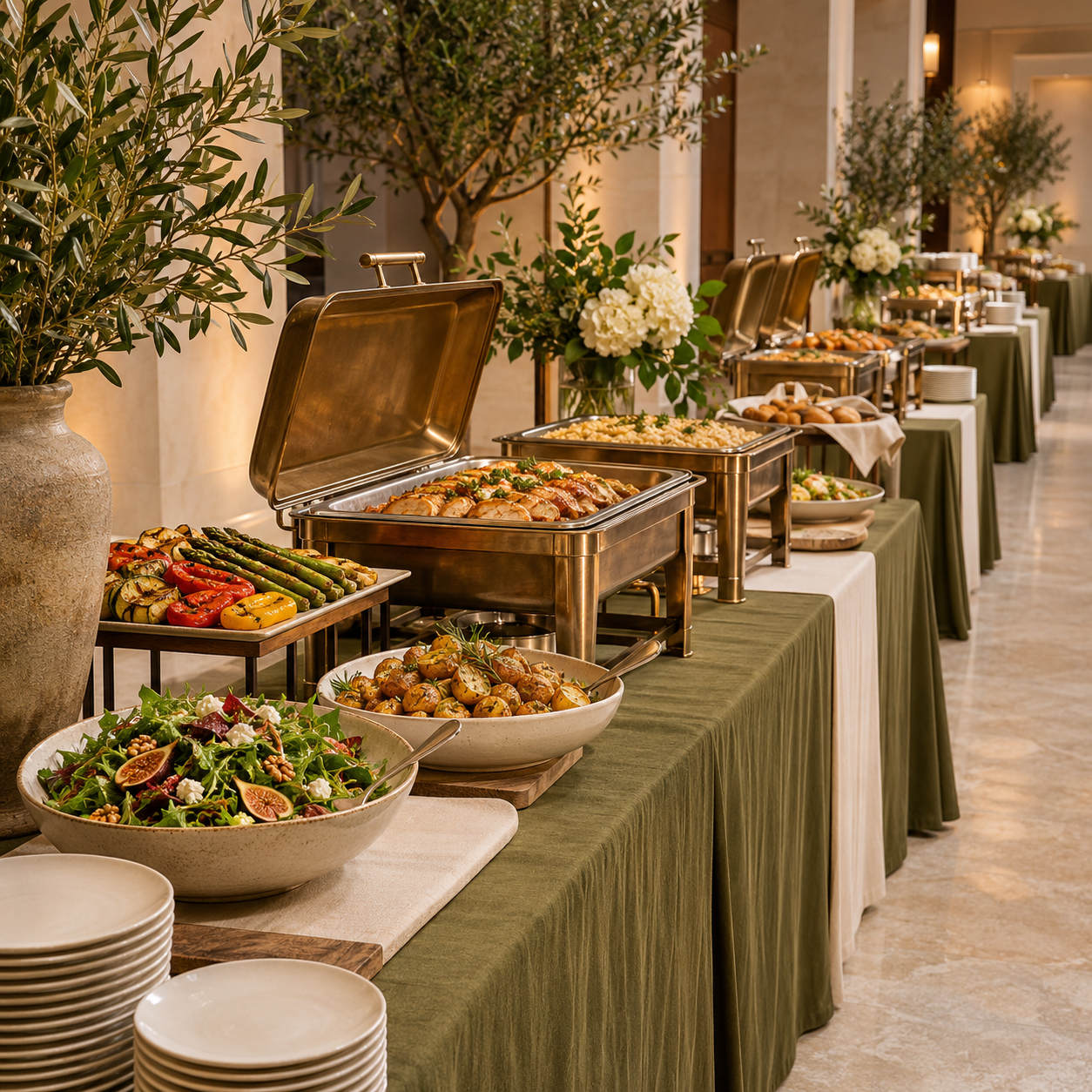
A menu written without regard for the venue's kitchen is a menu that may not survive the night. A venue that lists a 'full commercial kitchen' may have a six-burner range and one convection oven — enough for a plated dinner of sixty, not enough for a buffet of two hundred. A menu that assumes equipment the room does not have forces the kitchen to improvise, and improvisation under service pressure is where quality drops. The fix is a venue walkthrough before the menu is finalized, and a menu designed around what the room can actually support.
The walkthrough is where the menu meets the room. Open every oven, count the burners, find the sink, measure the counter, and walk the path from the kitchen to the farthest table. A caterer who walks the venue and then revises the menu to fit the kitchen is doing the work in the right order; one who confirms a menu the room cannot support is selling. The difference shows up in service.
If the venue has no kitchen at all, the menu must be built for portable equipment — dishes that finish beautifully on butane burners and induction plates. That is not a limitation so much as a design constraint, and a from-scratch kitchen can work within it beautifully, but only if the constraint is known before the menu is written, not discovered at load-in.
Mistake 3: a timeline that ignores the other vendors
The catering timeline is one of several moving through the room on the night, and a timeline built in isolation collides with the others. The photographer wants the couple during golden hour; the band has a set change that interrupts service; the venue has a curfew that ends the bar. A catering timeline that ignores these fixed points produces a kitchen firing a course while the room is empty, or a bar closing while the dance floor is full. The fix is a shared timeline, built with your other vendors, that names the fixed points and works the catering around them.
Share the full vendor list with the caterer at the proposal stage, not the week of the event. A caterer who knows the photographer's golden hour can schedule the first course around it; one who learns of it the day before cannot. The timeline is a coordination document, and it is only as good as the information it is built from.
Build slack into the timeline. A timeline planned tight — every minute accounted for, no buffer — is one delay away from a cascade. A bartender late, a speech running long, a course that needs five more minutes: each pushes everything after it. A timeline with slack absorbs the unexpected and keeps the evening flowing; one without it jams at the first surprise.

Mistake 4: dietary needs gathered too late
Dietary needs collected after the menu is written produce substitute plates that feel like afterthoughts, and in the worst case produce a safety failure. A guest with a celiac-level gluten restriction needs dedicated preparation and separation; a kitchen that learns of it the day before cannot guarantee either. The fix is to gather dietary information with the RSVPs, consolidate it into a single list, and share it with the caterer before the menu is finalized — not after.
Be specific about the category. An allergy is a protocol; a preference is a design input. A from-scratch kitchen can handle both, but only if it knows which it is planning for. Ask guests to be precise — 'celiac, needs dedicated prep' is a different sentence from 'prefers to avoid bread' — and pass that precision to the caterer. Vague dietary information produces vague accommodations, and vague is not safe for an allergy.
Map the dietary needs to seats or tables, not just to a count. On the night, plates for those guests are marked, fired separately or pulled from a dedicated batch, and delivered by a server who knows which seat receives them. A dietary list that names the need but not the seat is a list the kitchen cannot execute under service pressure. The mapping is what makes the system work.
Mistake 5: no final walkthrough and no debrief
The final walkthrough — a brief check-in as the date approaches — is where the remaining unknowns are closed and the last questions are answered. A host who skips it arrives at the day with open items that become problems under pressure. Confirm the count, walk through any menu changes, review the timeline, and confirm the logistics: load-in time, kitchen access, rental delivery. A thirty-minute conversation a week before the event prevents a dozen small failures on the night.
The debrief after the event is the mistake hosts never make twice once they have made it once. A short conversation within a day or two — what ran on time, what ran long, what the room taught the team — is what separates a caterer you can rebook from one you simply used. It is also where you learn what to do differently next time, and where the caterer learns your table for the next event.
At Ambrosía, that closing conversation is part of the service. Your submission is an inquiry, and every detail — from the firmed count to the final walkthrough to the debrief — is confirmed with you individually before and after the date. The plan that prevents these mistakes is the plan that is built with you, not handed to you, and the difference shows up in an evening that runs.
Frequently asked questions
When should I firm the guest count?+
Set a firm deadline about a week to ten days before the event, and communicate the final count to the caterer in writing. The kitchen needs the number to shop, prep and staff accurately.
What if my venue has a small or no kitchen?+
The menu is designed around what the room can support — dishes that finish on portable equipment, or more preparation brought in ready. A venue walkthrough before the menu is finalized determines what is realistic.
How do I build a timeline that works with my other vendors?+
Share the full vendor list with the caterer at the proposal stage, identify the fixed points (golden hour, set changes, curfew), and build the catering timeline around them. Add slack to absorb delays.
When should I collect dietary needs?+
With the RSVPs, before the menu is finalized. Consolidate the list, distinguish allergies from preferences, and map each need to a seat or table for the service team.
What is a final walkthrough and do I need one?+
A brief check-in about a week before the event to confirm the count, review menu changes, and confirm logistics. It closes open items before they become problems on the night.
What happens if the count changes at the last minute?+
A small buffer (named as a buffer) can absorb a late addition. A large change inside the kitchen's prep window forces compromises in quality and staffing, so firm the count by the deadline.
Does Ambrosía confirm these details for events outside Aubrey?+
Yes. Ambrosía serves event venues across Texas and Florida; travel and availability are confirmed by date and venue, and the count, timeline and logistics are confirmed with the host individually.
Source notes
- ✦Planning guidance reflects standard chef-led catering practice; specific venue and event details always shape the plan.
- ✦Dietary-handling guidance reflects general food-safety practice; venue and local rules always take precedence.
- ✦All Ambrosía events are planned with the host individually, and availability is confirmed per date and venue.