
When you are hosting an evening at home, the choice between a private chef and a catered meal is not really about food — both can produce an excellent menu. It is about the kind of evening you want to have. A private chef cooks in your kitchen, plates each course for your table, and becomes part of the rhythm of the night. A catered meal is prepared off site, delivered ready, and set up for you and your guests to serve yourselves. Each format suits a different occasion, a different guest count, and a different idea of what the evening should feel like. This guide compares the two honestly so you can choose the one that fits your night rather than the one that sounds more impressive.
It is written for hosts weighing the question in Texas and Florida, and reflects how Ambrosía approaches both: every menu written from scratch, every detail confirmed with you before anything is booked, and availability confirmed individually for each date and venue. The format is a design decision, and it should be explained in terms of your specific evening.
What a private chef evening actually looks like
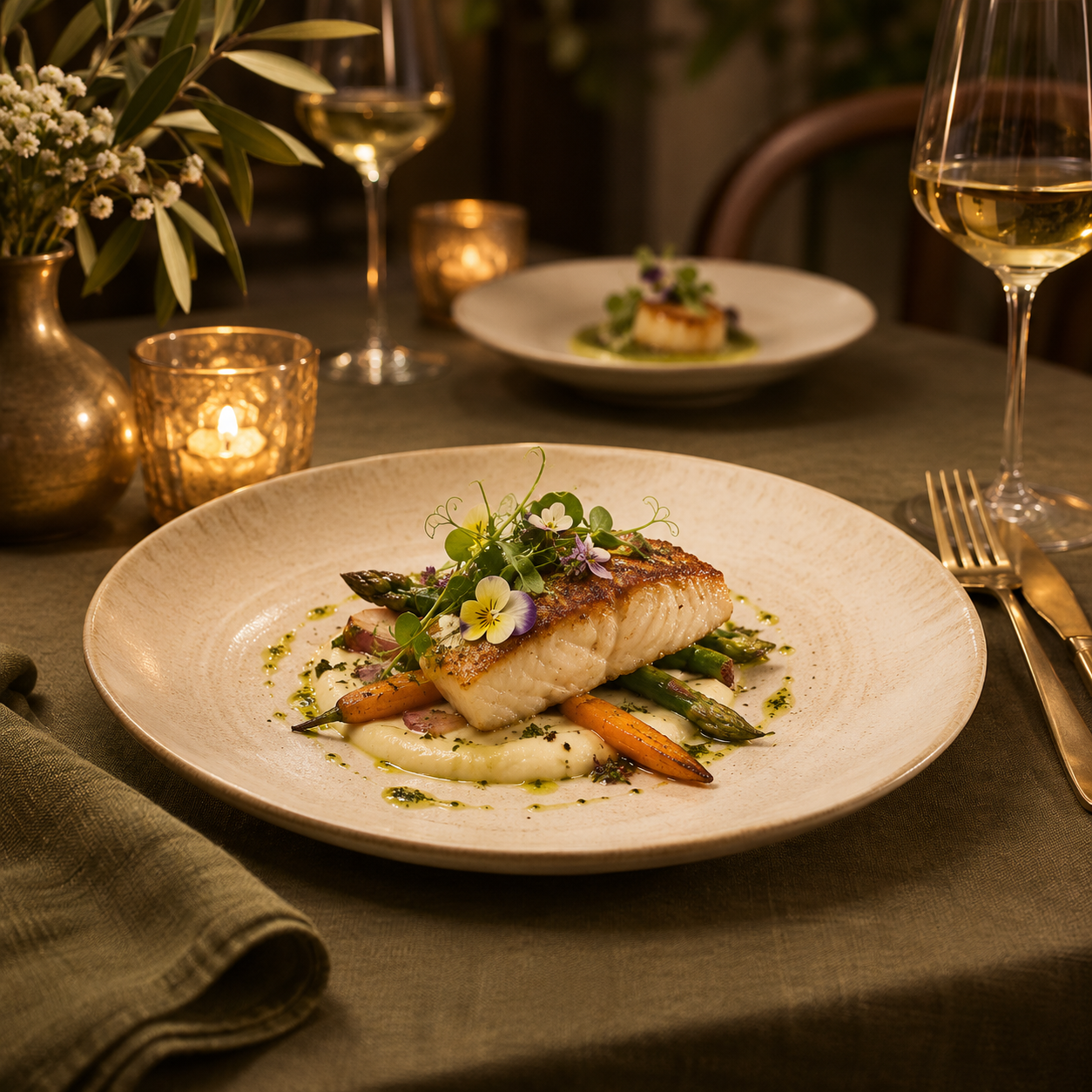
A private chef evening is built around presence. The chef arrives with the ingredients and the plan, cooks in your kitchen, and plates each course directly to your table. Courses arrive in sequence, paced for conversation, and the chef is available between them to describe what you are eating, answer questions, and adjust on the fly — a guest who arrives late, a course that should be held, a wine that needs opening. The evening unfolds like a restaurant that happens to be in your home, with the cook a few steps away rather than behind a closed door.
That presence is the product, and it shapes the format. A private chef works best for smaller counts — typically two to a dozen guests — because the cooking, plating and service all happen in one kitchen by one person (or a small team). Beyond that range, the kitchen becomes the bottleneck: too many plates to finish at once, too many courses to pace, too much for a single cook to watch. The format is intimate by nature, and it is most powerful when the table is small enough that the chef can know each guest's plate.
What you are buying is the evening returned to you. The hours you would have spent planning, cooking, timing courses and cleaning are given back, and you sit at your own table as a guest. The cost reflects that: private chef service is typically quoted per event or per person, covering the chef's time, groceries, service and travel. It is not the least expensive option, but it is the most personal, and for the right occasion it is the one that changes the shape of the night.

What a catered meal at home actually looks like
A catered meal is built around delivery. The food is prepared in a commissary or off-site kitchen, transported to your home in hot and cold carriers, and set up — on a buffet line, in chafing dishes, or plated and ready to be passed — for you and your guests to serve yourselves or to be served by a small team. The cooking is done before the chef arrives; what happens at your home is finishing, holding and service. The format trades the live-cooking presence of a private chef for scale, variety and a lower staffing footprint.
That scale is where catering earns its place. A catered meal can comfortably serve twenty, forty or more guests from a setup that fits in a home kitchen and dining area, because the production bottleneck — the cooking — has already been solved off site. The menu can be wider, too: a buffet spread offers more choices than a single plated progression, and guests can select portions and combinations to their taste. For a gathering where mingling and choosing matter more than synchronized courses, catering is often the better fit.
The trade-off is the evening's texture. A catered meal arrives finished; the cook is not part of the room, and the courses do not unfold in sequence with a chef watching your table. The food can be excellent, but the experience is closer to a well-run event than to a restaurant in your home. If the evening is about the food as a shared, paced event — an anniversary, a milestone birthday, a small dinner party — that texture matters. If it is about feeding a room of people well while they socialize, it matters less.

Matching the format to your count and your evening
The guest count is the first filter, and it is close to decisive. A private chef is the natural choice for two to roughly twelve guests — the range where one cook can plate and pace a multicourse dinner from a home kitchen. Above that, the kitchen becomes the constraint, and a catered meal — finished off site, set up for service — scales more gracefully. There is no hard line, and a skilled chef with a sous-chef can push the private format higher, but the count tells you which format the evening is pulling toward.
The tone is the second filter. Ask what the evening is for. An anniversary dinner for six wants the intimacy of a private chef — courses paced for conversation, the cook present, the table the center of the night. A neighborhood gathering for thirty wants the flow of a catered meal — guests choosing, circulating, the food supporting the socializing rather than commanding it. A corporate dinner for ten could go either way: a private chef if the meal is the event, catering if the meal supports a meeting or a presentation.
The venue is the third filter, and at home it usually favors the private chef for small counts and catering for large ones. A home kitchen is built for a family, not a banquet; a private chef works within it beautifully for a dozen, but a catered setup for forty may need the cooking done elsewhere simply because the kitchen cannot produce that volume. Share your count, your kitchen and your vision, and let the format follow from the facts rather than from a preference for the word 'chef.'
Cost, staffing and what each quote should tell you
Cost is where the two formats diverge most clearly, and where hosts most often misread the comparison. A private chef quote is typically per event or per person and covers the chef's time, groceries, service and travel — one number that represents one person doing everything. A catered meal quote is often lower per head because the cooking is batched off site and the staffing is smaller, but it may add line items the private chef folds in: delivery, equipment rental, separate service staff, and sometimes rentals for chafing dishes and serving ware.
The honest comparison is total to total, scope to scope. Ask each quote what it includes and what it does not. Does the private chef quote cover groceries and cleanup, or are those separate? Does the catered quote include delivery, setup, service staff and breakdown, or are those add-ons? Two quotes at different per-head numbers may represent the same evening once the line items are reconciled — or very different evenings. A quote that is vague about what is included is a quote where the surprises live.
Staffing follows the format. A private chef evening for eight may be one chef who cooks and serves, or a chef with one server for a more formal pace. A catered meal for thirty may need two to three servers to manage a buffet and clear, plus the delivery and setup team that comes and goes. Neither is wrong, but the staffing should be named in the proposal, not discovered on the night. At Ambrosía, every quote is personalized — built from your menu, your count and your venue — and confirmed with you before booking.
Questions to ask before you choose
Once you understand the two formats, the practical questions are what separate a good fit from a forced one. How many guests, and is that number firm? What does your kitchen support — oven, cooktop, counter space, sink — and can it handle the format you are considering? What tone did you describe to your guests, and does the format match it? What is your actual budget range, and how does each format's staffing sit against it? A caterer who asks these questions before quoting is doing the work; one who quotes first and asks later is selling.
Dietary needs interact with the choice more than hosts expect. A private chef handles them most personally, because each plate is built to specification and the chef knows each guest's needs by name. A catered meal can accommodate variety well but requires clear labeling and separated dishes to do so safely, especially at a buffet where guests serve themselves. If dietary needs are a significant part of your guest list, that alone may steer the format toward the one that controls the plate most directly.
Finally, ask about the evening's arc. A private chef can pace courses around a toast, a speech or a gift; a catered meal is more static once set up. If your evening has fixed moments the food should bend around, the private format flexes more naturally. If the evening is a steady social flow with no fixed sequence, the catered format supports it without forcing a structure it does not need. The format should serve the evening, not the other way around, and the right choice is the one that lets the night unfold the way you imagined it.
Frequently asked questions
What is the main difference between a private chef and a catered meal?+
A private chef cooks in your kitchen, plates each course and is present throughout the evening. A catered meal is prepared off site, delivered ready, and set up for you or a small team to serve. One is intimate and paced; the other scales and flows.
Which format is better for a small dinner party?+
A private chef is usually the better fit for two to about twelve guests, because the cooking, plating and pacing all happen in one kitchen by one person. The format is intimate by nature and most powerful when the table is small.
Which format is better for a larger home gathering?+
A catered meal scales more gracefully for twenty guests or more, because the cooking is done off site and the setup fits in a home kitchen and dining area. The private format becomes constrained by kitchen capacity above roughly a dozen.
Is a private chef more expensive than catering?+
Often yes per head, because one person does everything, but the comparison should be total to total and scope to scope. A catered quote may add delivery, equipment, service staff and rentals as separate line items. Ask each quote what it includes.
How do dietary needs affect the choice?+
A private chef handles them most personally, building each plate to specification. A catered meal can accommodate variety but needs clear labeling and separated dishes, especially at a buffet. Significant dietary needs may steer the choice toward the format that controls the plate most directly.
Can a private chef pace courses around a toast or speech?+
Yes — a private chef flexes naturally around fixed moments because the cook is present and the courses unfold in sequence. A catered meal is more static once set up and supports a steady social flow without forcing a structure.
How do I get a quote for either format?+
Share your date, guest count, venue and dietary needs through the inquiry page or call (469) 268-9100. Every quote is personalized — built from your menu, count and venue — and confirmed with you before booking.
Source notes
- ✦Format comparison reflects standard private-chef and catering practice; specific staffing and scope always depend on the event and venue.
- ✦Dietary-handling guidance reflects general food-safety practice; venue and local rules always take precedence.
- ✦All Ambrosía menus are written from scratch and the format is confirmed with the host before booking.